
GET PRO
LOCAL SCANNING & PRIVATE RESULTSScan contents and file paths stay on your computer.
Found an old PC, USB, backup, or hard disk?

Your old PC might hold a crypto fortune

Scan PCs, old drives, USBs and backups for wallet files, seed phrases, private keys and browser-wallet traces. Choose a scan type, review confidence and coverage, and follow the evidence. Home and Technician also recover eligible deleted NTFS data.

Plug it in — Start the scan — Find clues to lost crypto
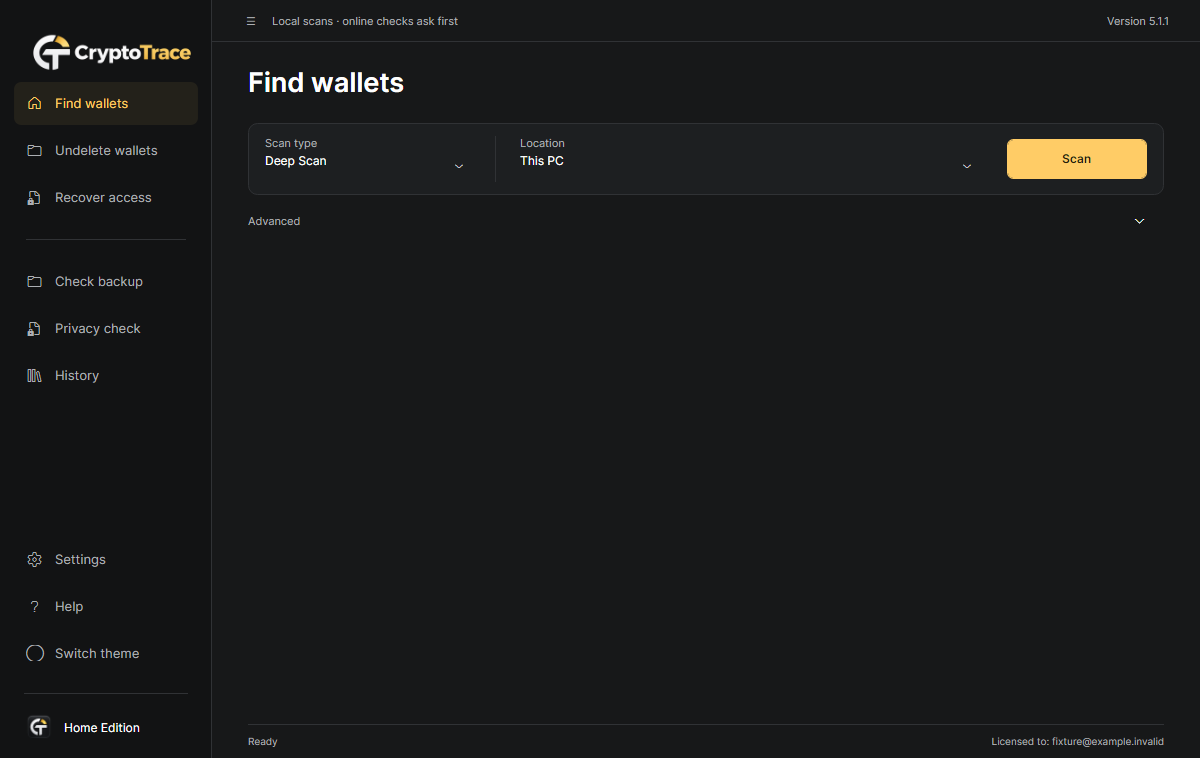
CryptoTrace 5.1.1 Find wallets: scan type, source selection, Advanced and the Scan button

Scan for wallet files, keys and seeds

NEW UPDATECryptoTrace v5.1.2October 15, 2026Clearer screens and diagnostics: Refined wallet-access, scan-results and supporting screens, with application diagnostics translated across all ten app languages.See what's new
CryptoTrace 5.1.2

What happened to your wallet?

If you still have the drive, search it for wallet files or try to recover deleted ones. If you already have an encrypted backup, go straight to password recovery.

The complete feature guide
Find wallets

Find wallet files on an old drive.

You don’t need to remember the filename. Search old PCs, USB drives and backups for wallet files, private keys and recovery phrases.

How wallet search works
Illustrative CryptoTrace 5.1.1 wallet results with confidence, next steps and report controls
Illustrative wallet results in the actual app. These examples are not customer wallets or proof of funds.

Search where you last used crypto

Choose a quick search of known locations, or read file contents with Deep Scan.

Pick up where you left off

Save a check and compare what appears in the next scan.

Undelete wallets

Recover deleted wallet files.

A deleted file may still be on the disk. Search an eligible NTFS drive for wallet data that hasn’t been overwritten, and save what can be recovered.

How deleted-wallet recovery works
CryptoTrace 5.1.1 deleted-wallet recovery with physical drive and separate output disk
Actual CryptoTrace 5.1.1 Windows interface, shown in English.

Read the source. Save somewhere else.

Recover to another physical disk so the output doesn’t overwrite the data you’re trying to save.

Know what was recovered

Review saved files, coverage warnings and the recovery manifest. An encrypted wallet stays encrypted.

Recover passwords

Recover a forgotten wallet password.

Try a password you remember, or search variations based on your own hints. Recovery runs on your PC, using a copy of a supported encrypted wallet.

See password-recovery options
CryptoTrace 5.1.1 Recover access: wallet backup, recovery method and protected sessions
Actual CryptoTrace 5.1.1 Windows interface, shown in English.

Use the clues you remember

Review the search and its limits before starting. CPU search, with optional GPU support for eligible jobs.

Check your wallet format first

Supported Bitcoin Core, Ethereum, Electrum and MetaMask formats. Not every variant can be opened.

Local checks. Read-only source access.
Use only files and drives you own or have permission to examine. Recovery depends on the format and the data still available.

Explore every feature

Forensic-Grade Crypto Discovery

BitcoinEthereumLitecoinDogecoinMoneroDashZcashXRPBitcoin CashBNBBitcoinEthereumLitecoinDogecoinMoneroDashZcashXRPBitcoin CashBNB
PolygonArbitrumOptimismAvalancheCardanoSolanaPolkadotKusamaTronPolygonArbitrumOptimismAvalancheCardanoSolanaPolkadotKusamaTron

Scan for wallet files, keys and seeds

You don’t need to remember the filename. Search old PCs, USB drives and backups for wallet files, private keys and recovery phrases.

Offline-first Scanning

No internet required. All analysis runs locally on your machine; nothing leaves your disk. Ideal for forensic and privacy-first workflows.

Choose the right scan

A search of your current browser profile is different from a search of an old external disk. Choose Quick, Deep, Old drive/folder or Browser wallets to match the source. Technician also lets you scan supported disk-image files.

Bitcoin Core — wallet.dat
MetaMask — browser vault
BIP39 — seed phrase
Electrum — wallet file

Search for deleted wallet material

Read supported NTFS drives and save eligible deleted files, seed phrases or keys to another physical disk. Home and Technician; recovery and funds are not guaranteed.

CryptoTrace
$

Detailed Reports

Filter or search the list, open the details and read the suggested next step. Home and Technician show full paths, open the source location and export JSON or HTML reports. Copy Safe Summary gives you a way to share a finding without copying the detected secret itself.

Smart Signatures1,000+

Professional-Grade Value

Trial proves value with hidden-path leads. Pro unlocks exact recovery paths, unlimited scans, reports, and Open Location actions.

Use Cases

Powerful Use Cases

Old PCs & Backups

External Drives & USBs

Browser Extensions

Corporate Audits

Recover from:

  • Forgotten seed phrases and private keys
  • Browser extension wallets (MetaMask, Phantom, TronLink)
  • Old backups, disk images, and archived folders
  • Eligible deleted wallet files and recovery material on supported NTFS drives
How It Works

From choosing a scan to reviewing the findings

CryptoTrace 5.1.1 Find wallets: scan type, source selection, Advanced and the Scan button
01

Choose a scan type

Quick checks known wallet locations. Deep searches file contents. Old drives and Browser wallets focus the search; Technician adds forensic-image candidate scans.

02

Choose where to scan

Select This PC, a drive or a folder. Use Advanced for a custom path and Settings for exclusions and an SSD, NVMe or HDD performance profile.

03

Run the scan

Click Scan and follow progress. Review completion and coverage warnings; a stopped or limited scan does not prove that no wallet exists.

04

Review and keep the evidence

Filter findings by confidence, inspect recovery leads and choose the next step. Paid editions reveal full paths and export JSON/HTML reports; Copy Safe Summary redacts secrets.

Buy CryptoTrace

Choose your License

One-time license for local discovery and repeatable checks. Choose personal use or commercial customer recovery work. Read supported NTFS drives and save eligible deleted files, seed phrases or keys to another physical disk. Home and Technician; recovery and funds are not guaranteed.

Limited-time launch offer ends in
16Days
04Hours
16Minutes
04Seconds
For businesses

Technician License

Commercial use
€399€199
One-time payment
  • All Home features
  • Deleted-wallet recovery · supported NTFS drives
  • Unlimited customer machines · commercial use
  • Sequential queue: up to 10 sources
  • Forensic disk-image candidates
  • Named customer cases and notes
  • Recorded recovery steps and HTML handover
  • Password-encrypted .ctcase reports
FAQ

Frequently Asked Questions

What does CryptoTrace detect exactly?

Wallet artifacts, validated recovery material and public traces; supported exchange-account clues; and labelled credentials, password-export CSVs and private-key containers in Privacy check. Unsupported areas are not a clean-device certificate.

Does CryptoTrace upload any data or modify files?

Checks are read-only and local. Saved history keeps paths and metadata locally, not raw secret values. Trial telemetry sends app-use metadata; optional public Bitcoin lookups send the selected address only after consent.

What are the Trial vs Pro limits?

Trial has three uses shared between scans and backup checks, with recovery paths hidden. Home adds unlimited checks, full paths, reports, saved comparisons, backup comparisons and repeat checks. Technician includes Home plus customer cases, notes, a ten-source queue, image candidates and encrypted reports.

How accurate is detection? How are false positives reduced?

Checksum and structure validators, context checks, noise suppression, and deduplication reduce false positives.

Can I scan external drives or choose a custom path?

Yes. Attach or mount the drive and choose its path, or enter a custom folder.

Which performance profile should I choose?

Balanced (default), NVMe High for very fast SSDs, or HDD Safe for slower disks.

How do I save and share reports?

Pro can save JSON and HTML recovery reports. Safe Summary copies a redacted support summary without paths, seeds, keys, or full tokens.

What files are intentionally ignored and why?

Noisy system artifacts, large or binary files, and known irrelevant caches are skipped or given lower priority.

How is licensing enforced?

Pro uses a signed license file verified locally by the app. Production builds reject unsigned licenses.

Support and contact

Email hello@crypto-trace.app. See the Help Center for guides.

Can it confirm my backup will restore access?

An identical hash does not prove a backup is healthy or restorable. Recognizing a database header does not validate the wallet records inside it. You have the wallet file, but the password is missing or uncertain. Recover access works from a preserved copy. Try a password you remember, or define a limited search from your own hints, such as words and variations you may have used. The work runs locally. Supported formats include Bitcoin Core legacy/descriptor wallets, Ethereum v3 PBKDF2/scrypt, standard Electrum encrypted JSON/BIE1 and complete direct MetaMask vaults. Eligible jobs can use a trusted Hashcat GPU backend; CPU fallback and independent CPU verification check the outcome. Protected sessions let you resume eligible work. Home/Technician required. Not every format variant is supported. A large search can take a long time and may find nothing. Use only wallets you are authorized to open.

Do repeat checks run when I close the app?

No. Daily/weekly checks run only while CryptoTrace is open. Missed checks run after reopening when the app is idle. No Windows service or startup task is installed.

Is an empty Privacy check safe to share?

Not necessarily. Read the coverage details: encrypted or nested archives, images, PDF/OCR and unsupported formats are not inspected. Correct a working copy yourself and check again; CryptoTrace does not delete files or revoke credentials.

Can CryptoTrace recover deleted wallet data?

Home and Technician include deleted-wallet recovery. Choose Deleted wallets, select the physical drive and save to another physical disk. Trial requires activation before recovery starts. Supports 512-byte logical sectors, including 512e; 4Kn is unsupported. Overwritten, erased or incomplete data may be unrecoverable. Encryption is preserved; recovered files can contain secrets. Recovery, wallet access and funds are not guaranteed. Trial cannot run or preview deleted-data recovery. Activate a paid Home or Technician license to start it.

Which scan type should I choose?

Quick checks known wallet locations. Deep searches file contents. Old drives and Browser wallets focus the search; Technician adds forensic-image candidate scans. Select This PC, a drive or a folder. Use Advanced for a custom path and Settings for exclusions and an SSD, NVMe or HDD performance profile.

Recover a password for an encrypted wallet

You have the wallet file, but the password is missing or uncertain. Recover access works from a preserved copy. Try a password you remember, or define a limited search from your own hints, such as words and variations you may have used. The work runs locally. Supported formats include Bitcoin Core legacy/descriptor wallets, Ethereum v3 PBKDF2/scrypt, standard Electrum encrypted JSON/BIE1 and complete direct MetaMask vaults. Eligible jobs can use a trusted Hashcat GPU backend; CPU fallback and independent CPU verification check the outcome. Protected sessions let you resume eligible work. Home/Technician required. Not every format variant is supported. A large search can take a long time and may find nothing. Use only wallets you are authorized to open.

Choose what the scan will read

A search of your current browser profile is different from a search of an old external disk. Choose Quick, Deep, Old drive/folder or Browser wallets to match the source. Technician also lets you scan supported disk-image files. Advanced lets you choose a source. Settings holds exclusions, reading limits and disk profiles. Excluded paths and resolved link targets stay outside the scan. Coverage details explain where a limit, unreadable file or skipped location left a gap. Optional fast reuse trusts file size and modification time. A change that preserves both may be missed. Reuse is a speed choice, not a fresh read.

Don't throw away a crypto fortune.

Scan for wallet files and recovery material. Review findings, recover eligible deleted data and check backups before sharing.